Gymshark Pricing Strategy Breakdown: Shopify Discounts, Product Launches, and Ecommerce Growth
We analyzed Gymshark’s Shopify store using StoreScout to break down its discount strategy, product launch velocity, pricing architecture, catalog positioning, and ecommerce competitor intelligence signals.
Quick Summary
- Gymshark uses aggressive discounts across a large portion of its public Shopify catalog.
- Newer product launches were priced above the overall catalog median, suggesting premium expansion.
- The dominant price band was $25–$49, showing where Gymshark primarily competes.
- The store showed strong launch velocity, catalog complexity, and ecommerce positioning signals.
- This breakdown shows why Shopify competitor analysis should go deeper than manually browsing product pages.
Gymshark is one of the most recognizable ecommerce fitness brands, but the interesting part is not just the products — it is how the store structures pricing, discounts, launches, and catalog positioning.
Most Shopify stores look at competitors and copy surface-level details like product names, prices, or website design. But real Shopify competitor analysis goes deeper.
After analyzing Gymshark’s public Shopify catalog data with StoreScout, several patterns stood out: aggressive discount usage, strong product launch velocity, premium-priced new products, and a pricing structure designed to keep customers moving through the store.
Gymshark Uses Discounts Aggressively
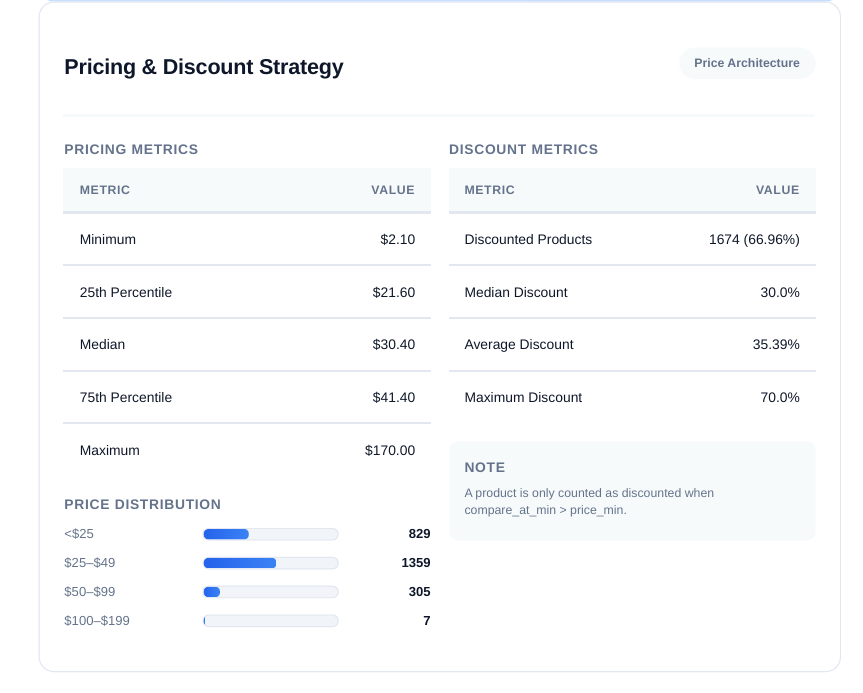
One of the clearest patterns in Gymshark’s storefront is how aggressively the brand uses discounts.
That kind of discount activity creates constant movement across the storefront. It gives shoppers the feeling that there is always a deal, a limited opportunity, or a reason to act now.
But the more interesting part is where those discounts appear.
In the analyzed catalog, discounted products had a median price of $26.60, while full-price products were closer to $42.00. That suggests Gymshark may be protecting higher-value products while using lower-priced items to drive conversion and urgency.
The Dominant Gymshark Price Band Is $25–$49
Gymshark’s public Shopify catalog showed a clear dominant price band.
The $25–$49 range accounted for the largest share of products, with 1,359 items in that band. That made up more than half of the analyzed catalog.
This matters because price bands reveal where a brand primarily competes.
For Gymshark, the catalog appears built around accessible fitness apparel pricing, while still leaving room for higher-priced premium products like lifting belts, backpacks, and specialized gear.
Gymshark Launches Products at an Aggressive Pace
Another major signal was how quickly Gymshark expands and refreshes its catalog.
That level of product launch velocity is unusually aggressive compared to most smaller Shopify stores.
Frequent launches help a brand:
- keep the storefront feeling fresh,
- give customers new reasons to return,
- create more content and campaign opportunities,
- test demand across product lines,
- and build momentum around collections.
Many smaller ecommerce stores let their catalogs go stale. Gymshark appears to treat product launches as part of the growth engine itself.
New Products Point Toward Premium Expansion
One of the most interesting findings was the pricing difference between Gymshark’s overall catalog and its newer products.
Newer products were priced significantly above the overall catalog median.
This suggests Gymshark may be gradually pushing customers toward higher-value products over time instead of competing purely on cheap prices.
That is one of the most important lessons for Shopify brands: premium positioning does not always require raising the price of every product at once.
A brand can introduce premium perception through:
- new launches,
- bundles,
- limited collections,
- higher-value hero products,
- and stronger product positioning.
Catalog Complexity Is Part of the Strategy
The report also showed high catalog complexity, which makes sense for a mature fitness apparel brand.
Gymshark’s storefront includes a large catalog, broad price spread, and multiple product variants. Those variants matter because they create natural upsell and personalization opportunities through sizing, colors, fits, collections, and product tiers.
For newer Shopify brands, catalog complexity can become messy fast. But for larger ecommerce brands, it can support higher average order value and stronger customer segmentation.
What Smaller Shopify Stores Can Learn From Gymshark
Most smaller Shopify stores look at competitors and copy surface-level details: product names, pricing, page layout, or ad creatives.
But the real advantage comes from understanding the system underneath the storefront.
Gymshark’s public catalog suggests a few important lessons:
- Discounts can drive urgency, but they need structure.
- New launches can be used to push premium perception.
- A dominant price band helps define market position.
- Catalog freshness can support repeat visits and campaigns.
- Variants and product depth can create upsell opportunities.
This is why Shopify competitor analysis should go deeper than manually browsing a few product pages. Pricing, discount behavior, launch velocity, and product positioning all reveal how ecommerce brands compete.
Final Thoughts
Gymshark’s pricing strategy is not just about cheap discounts or frequent product drops.
The storefront appears to combine discounting, product launch velocity, catalog depth, and premium expansion into one connected ecommerce strategy.
Most Shopify brands copy products. Larger ecommerce brands engineer perception, pricing, and product flow intentionally.
More ecommerce pricing strategy breakdowns are available on the StoreScout blog. If you have questions about what StoreScout analyzes, visit the FAQ.
Related StoreScout Resources
Analyze a Shopify competitor automatically
StoreScout generates Shopify competitor analysis reports from public catalog data, including ecommerce pricing intelligence, discount strategy, product launches, catalog complexity, and product positioning signals.
Analyze a Shopify Store